
The model
How eCARE works
Six connected elements, delivered through the patient's own general practice: the patient's own priorities, continuous glucose monitoring, case conferencing, educator support, virtual education and practice audits — all enabled digitally so distance stops being the barrier.
1. Patient priorities
A questionnaire capturing the patient’s journey so far and what matters most to them, before anything clinical begins.
2. Glucose monitoring
Continuous glucose monitoring ahead of the case conference, and intermittently after when clinically appropriate.
3. Case conferencing
A virtual consultation with the patient and GP, connected to an endocrinologist and diabetes educator.
4. Educator support
Diabetes educators from the local hub and Western Sydney review progress and adjust care between conferences.
5. Virtual education
The Diabetes Together app and clinician dashboard, a curated video library, myINTERACT resources and the NADC Diabetes Care Course.
6. Practice and patient audits
Six-monthly diabetes-management reviews, screening and medication advice, and feedback to the practice.
Element one
The patient priorities questionnaire
Everything starts with the patient, not the pathology. Built into the Diabetes Together app, the questionnaire asks about the journey so far — how long they have lived with diabetes, what has been tried, what worked and what did not — and then what matters most to them right now.
Their story so far
Years since diagnosis, treatments tried, what got in the way — context that rarely fits inside a standard consultation.
What they actually want
Fewer hypos, energy for the grandchildren, keeping their licence, avoiding insulin — the goal the plan should be built around.
Read before the conference
The specialist and educator see it in advance, so the meeting starts from the patient’s priorities rather than working towards them.
Element two
Continuous glucose monitoring
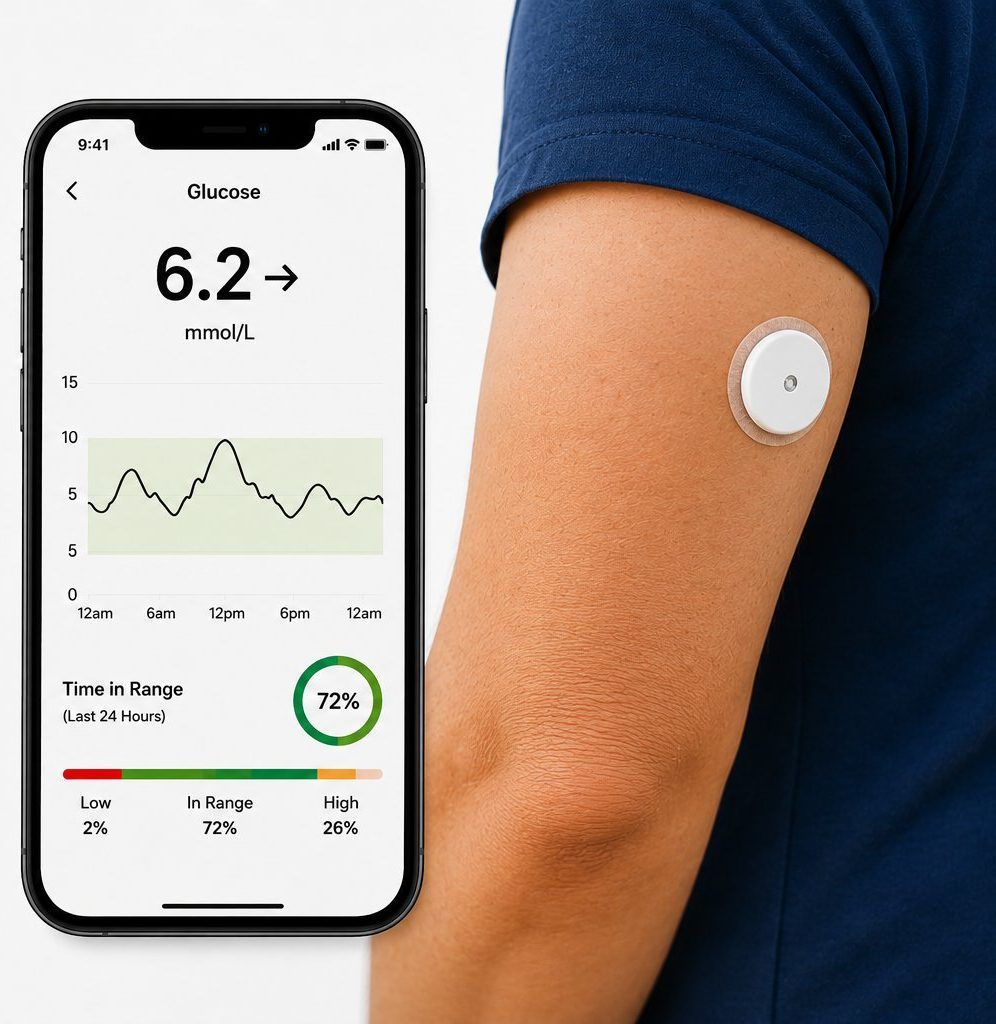
A small sensor worn on the back of the arm reads glucose every few minutes, day and night, and sends it to a phone. Two weeks of that shows what a handful of fingersticks never can. Participants wear one before each case conference, free of charge.
Why CGM helps
Sees what fingersticks miss
Overnight lows, after-meal spikes and the effect of daily activity all show up in the data, invisible to occasional finger-prick checks.
Motivates real change
Seeing glucose respond to a meal, walk or medication in real time gives patients an immediate, personal reason to adjust habits.
Sharpens the case conference
GPs and specialists use the detailed glucose profile to pinpoint problem areas and fine-tune medication timing and dosing.
Element three
Patient, GP, specialist and educator — in one conversation
A structured virtual consultation joining the patient and their GP with an endocrinologist and diabetes educator. The patient is in the room throughout: this is a conversation with them, not about them, and the plan that comes out of it is one they have agreed to.
How a conference runs
A 30-minute meeting, all of it by video — no travel for the patient or the practice.
Identify the patient
The practice nominates a patient with complex type 2 diabetes who would benefit from specialist input.
Gather the picture
Recent results, medications, complication screening and about two weeks of CGM data are pulled together before the meeting.
Meet by video
GP, specialist and educator talk it through together and agree what to change — medications, targets, referrals, follow-up.
GP carries the plan
The plan is documented and the GP continues care as usual. One or more follow-up conferences then review how the patient is tracking and refine the plan over the following months.
How it helps patients
Complex cases get genuine specialist input without a long wait, a trip to a metro clinic, or having to repeat their story to a new doctor — care stays anchored with the GP they already know.
How it helps providers
Each conference doubles as on-the-job learning — GPs build confidence managing complex diabetes independently, informed by real cases from their own patient list.
Why virtual, why Western NSW
Western NSW spans almost 250,000 square kilometres with few local specialists. Meeting by video brings a specialist endocrinology team to a rural GP's desk — no travel for anyone, and sustainable to run at scale.
Element four
Educator support
Diabetes educators from Western NSW and Western Sydney diabetes services work alongside the practice between conferences — so the plan agreed in the meeting actually happens.
- Support from the local diabetes hub, connected to the specialist team.
- Regular review of progress against the agreed management plan.
- Treatment adjustment and troubleshooting between case conferences.
- Personalised education built around the patient’s own priorities.
Element five
Virtual education
Education for both sides of the consultation — patients learning to read their own data, and practice teams building diabetes capability that outlasts the study.
- Diabetes Together app onboarding, tracking and AI coaching, including food-photo advice.
- A curated library of short educational videos for patients and practice teams.
- myINTERACT provider resources delivered to the practice.
- Access to the NADC Diabetes Care Course for participating clinicians.
Diabetes Together
Our version of the Health2Sync platform, free for the duration of the trial. A patient app pairs with a clinician dashboard, so the care team can see how someone is tracking between visits and offer advice — without being on call.
AI food-photo coaching
Patients photograph a meal and get immediate, practical advice on it.
Patient priorities questionnaire
Built in, so the case conference starts from what matters to the patient.
200+ education videos
A library patients can work through at their own pace.
Clinician dashboard
Glucose, activity and app data in one view, shared with the specialist team.
You are not signing up to be on demand. GPs get access to the dashboard and are welcome to use it, but responding to patient questions through the app is not your responsibility unless you choose to. The eCARE educator and specialist team monitor it as part of the trial.
Element six
Practice and patient audits
Every six months the study team reviews each participating patient’s progress against their agreed plan, and diabetes management across the practice as a whole, then feeds both back — a practical quality-improvement loop rather than a research extraction.
Patient-level review
Each participant’s glucose, medications and screening checked against the plan agreed at their case conference — so nothing quietly drifts.
Practice-level audit
A structured look at diabetes management across the whole practice population, not just study patients, with specialist advice on screening gaps and treatment intensification.
Feedback that builds confidence
Practice-level results shared back with the team, so improvement is visible and repeatable.
Privacy & data
Health information collected through these tools is handled under the trial's ethics approval and NSW Health privacy requirements. Patients are told exactly what is collected and how it is used before they consent.
No cost to take part
CGM sensors, the Diabetes Together app and the case conferences are provided by the trial. Patients pay nothing, and practices are supported through the study.
Could this model work in your practice?
We will walk your team through what is involved, with no obligation to join.